MARKET
Industry context & market
Orbital compute is defining the next decade of commercial space.
In 2025, multiple space-computing validation missions succeeded—marking a full shift from Commercial Space 1.0 (“do we have satellites?”) to 2.0 (“can we sustainably deliver value on orbit”). Space infrastructure no longer answers presence alone; it must deliver real commercial capability above the Earth.
At this turning point, companies that connect the full chain—from self-developed satellites and constellation networking to on-orbit compute operations—will hold a first-mover edge on product standards and service boundaries. XueChenXingHang, grounded in in-house manufacturing and constellation planning, is among the few full-stack pioneers in this arena.
Only a handful of satellites worldwide currently operate GPUs in orbit. Beijing has prioritized space computing among its future industries; Haidian District alone hosts more than 200 commercial space companies. XueChenXingHang participates in this wave through self-developed buses and a self-owned constellation, aiming to help shape standards for orbital compute infrastructure.
WHY ORBIT
Why put compute in orbit?
Three structural demands are pushing in-orbit edge compute from proof of concept to infrastructure-scale deployment.
-
Timeliness leap: hours to minutes
Classic workflows downlink raw data first, then process on Earth—often hours end to end. Compute satellites process on the fly and downlink structured results—compressing wildfire, disaster, and alert workflows to minute-scale response, and moving toward true pre-disaster early warning.
-
Energy breakthrough: a greener path for dense compute
AI has driven an explosion in demand for data-center power. Space offers abundant solar energy and natural radiative cooling—a greener, more efficient thermal and energy path for dense compute.
-
Orbital positioning: claim next-gen space infrastructure
Orbital slots and spectrum are finite and allocated on a first-come, first-served basis. Space-based compute and self-owned constellations are key to the positioning window and strategic initiative for next-generation space infrastructure.
MISSION
About XueChenXingHang
Founded in October 2025, Beijing XueChen XingHang Technology Co., Ltd. is a full-stack satellite solutions company focused on compute satellites.
With a self-built 20,000 m² smart satellite manufacturing facility, we deepen key technologies including on-orbit thermal control, thermoelectric waste-heat recovery, system integration, radiation hardening, and flexible solar arrays—while delivering low-cost batch production of advanced payloads such as AI compute modules, plus core platform products including avionics and power.
We plan a self-developed, self-owned constellation of 30 distributed compute satellites, building a complete industry loop from R&D and design through satellite manufacturing to constellation operations.
Our core team of 20+ engineers comes mainly from leading aerospace institutes such as the China Academy of Space Technology (CAST, the Fifth Academy) and the Second Academy, as well as major enterprises. We have established an R&D center at Beijing HQ and a manufacturing center in Xinxiang, Henan, with expanding R&D and sales networks in Shanghai, Chengdu, and beyond. Design of the first twin satellites is complete, with launch planned for late 2026.
Industry consensus points to large-scale space data centers closer to the 2030s. The near-term commercial window is on-orbit data processing—process and analyze where data is acquired—aligned with international peers such as Kepler Communications and other distributed edge-compute efforts in space. XueChenXingHang pursues a distributed compute constellation plus Earth observation full-stack route in line with that industry timeline.
Above the orbit · Compute without bounds
Brand film: an engineer drawing a satellite design with solar arrays.
CAPABILITIES
Core strengths
Our edge is not a single technical metric—it is end-to-end commercial capability from manufacturing to delivery.
-
Full-spectrum satellite manufacturing
Coverage across communications, navigation, EO, and compute satellites—meeting needs from networking and precision positioning to resource monitoring and edge compute.
Full satellite portfolio → -
In-house factory for low-cost batch production
A self-owned 20,000 m² smart satellite factory with hundred-satellite-class annual capacity. End-to-end control from core components to integration, with per-satellite delivery ~20% faster than the industry average.
In-house factory capacity → -
Integrated cross-scenario delivery
Comms + EO + compute packages for smart agriculture, emergency response, smart cities, and other space-information scenarios—integrated delivery from satellite to service.
Cross-scenario delivery → -
A decade of depth builds lasting moats
A core team with 10+ years in aerospace, continuously improving on-orbit performance and cost structure to build hard-to-replicate technical and industrial competitiveness.
Long-term technical moat →
SERVICES
Products & services
From raw data to intelligent analytics and real-time compute, we start with a practical leasing model and keep evolving toward next-generation orbital compute delivery.
Remote sensing–compute integrated satellites: process data where it is collected
We fuse Earth-observation payloads with high-performance onboard compute—integrating optical / IR / SAR sensors, space-grade AI processing, onboard storage, and high-speed inter-satellite links (ISL) and downlinks. The closed loop runs on orbit: imaging → preprocessing → AI interpretation → information filtering → lightweight result delivery.
Customer value
In ocean monitoring, emergency response, smart agriculture, and similar scenarios, downlinking raw EO data for ground processing can add tens of minutes of latency. Our remote sensing–compute satellites process data at the point of collection and return core results in seconds—not a single-metric upgrade, but a fundamental change in workflow efficiency.
Read about low-latency compute leasing →Compute constellation: distributed orbital networking
Our compute constellation uses distributed orbital networking, high-speed inter-satellite links, and space-to-ground collaborative scheduling—composed of the onboard compute fleet, an ISL fabric, space-to-ground transport, and a ground orchestration platform—forming an integrated system with space-based compute as the primary capability and terrestrial compute in support.
Explore the full constellation architecture →Low-latency compute leasing
Our primary commercial entry: on-orbit processing with second-level delivery of results—high-efficiency compute for ocean, desert, and other coverage gaps.
Low-latency compute leasing →Intelligent data processing
Onboard AI for acquisition, analysis, and decisions—cutting the cost of downlinking massive raw datasets.
Intelligent data processing →Resilience from orbit
When ground networks fail, orbital passes can still run critical workloads—layered resilience, security, and sustained ops.
Orbital business resilience →Long-term business models
Beyond compute leasing and intelligent data services, we are also exploring tokenized compute services and Space Compute as a Service. As the constellation scales, we aim to deliver metered, composable, platform-style orbital compute—evolving from “renting compute” to on-demand access to compute capability above Earth.
XueChen-01A & 01B dual-satellite platform
| Parameter | XueChen-01A | XueChen-01B |
|---|---|---|
| Orbital altitude | 535 km | |
| Mass | 150–160 kg | |
| Imaging payload | Visible | Infrared |
| Resolution | Sub-meter | — |
| Compute payload | 4 POPS @ FP8 | |
| Storage | 16 TB | |
| Space-to-ground / inter-satellite links | X-band microwave / laser | |
| Design life | > 5 years | |
Distributed compute with inter-satellite and space-to-ground laser links and EO synergy. Open orbit visualization
Platform overview →MISSION SERIES
Launch mission series
Building the self-owned compute constellation year by year: 2026 twin pathfinder validation, 2027 next-generation compute satellites and batch deployment.
2026 missions
XueChen-01A & 01B
First remote sensing–compute twin-satellite validation: visible + IR synergy, 4 POPS @ FP8 and 16 TB storage per satellite—closing the imaging–AI–high-speed-link loop.
View twin platform →2027 missions
XueChen-03 + 3 compute satellites
XueChen-03 (XC03 / Changyuan-01) leads as the next-gen compute satellite; three additional compute satellites launch the same year to continue constellation growth and on-orbit AI validation.
- XueChen-03 (XC03)—targeted for February 2027 · laser + AI + EO
- Three additional compute satellites—2027 launches (designations TBD)
PRODUCT · XC03
XueChen-03 (XC03)
Changyuan-01 · Compute satellite · On-orbit intelligent processing · Targeted for launch in February 2027
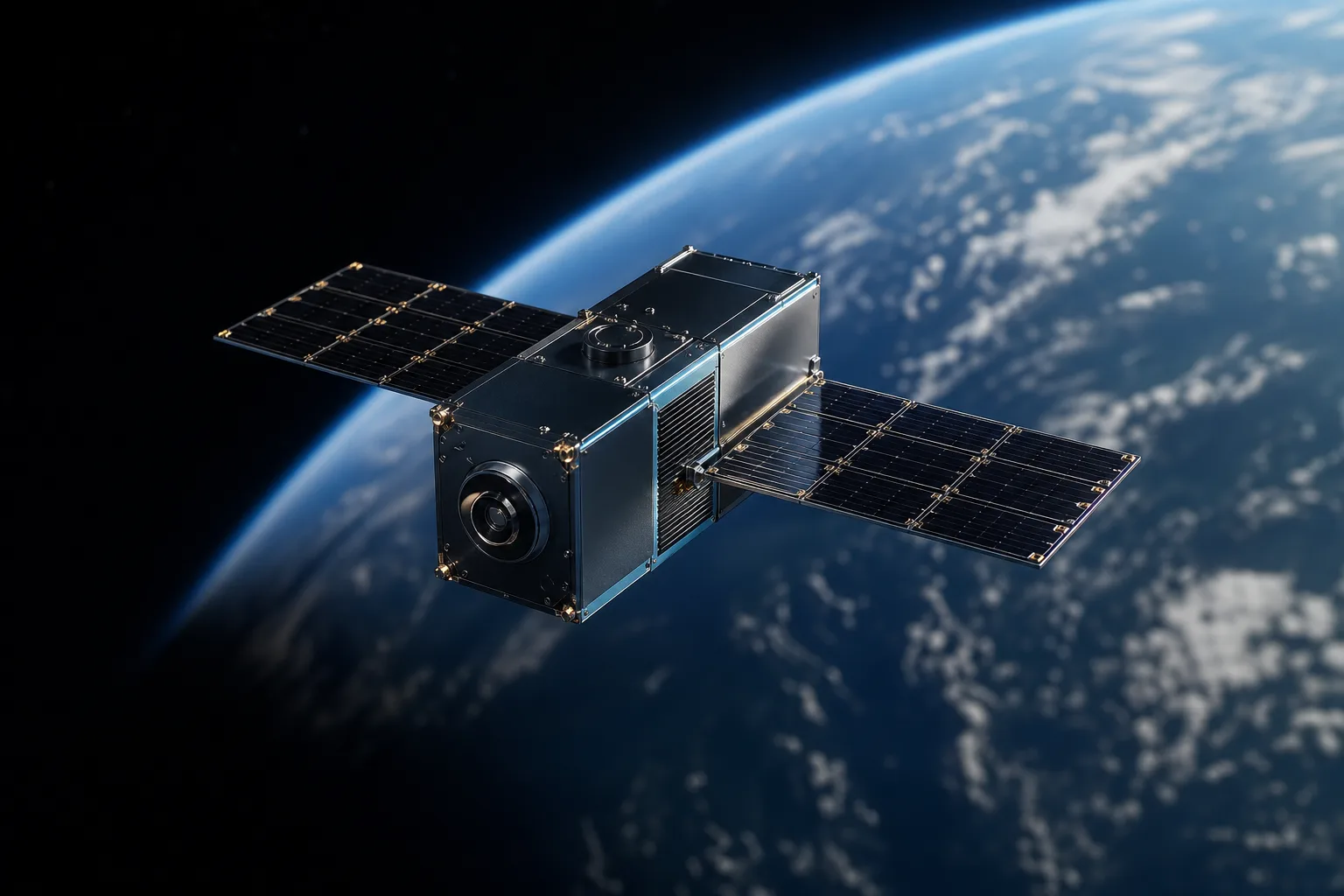
XueChen-03 is our next-generation compute satellite under development: a sun-synchronous orbit with laser terminals, a Zhijiang AI computer, and a high-resolution camera—delivering space-to-ground and inter-satellite laser links, on-orbit AI inference, EO imaging, and image–compute–downlink workflows. As the lead satellite of the 2027 mission series (targeted for February), three additional compute satellites will also launch that year—continuing from the 2026 XueChen-01A & 01B twin mission toward a planned ~30-satellite constellation.
Key specifications
- Orbit
- Sun-synchronous orbit (SSO), 525 km altitude, local time of descending node (LTDN) 10:30 AM
- Coverage
- Global between ±80° latitude; revisit period ≤ 5 days
- Attitude control
- 3-axis stabilized, zero-momentum bus; attitude measurement accuracy ≤ 0.03° (3σ), pointing accuracy ≤ 0.1° (3σ), attitude stability ≤ 0.05°/s (3σ)
- Slew capability
- ±35° roll maneuver; slew better than 25° / 180 s
- Mass
- 60 kg (bus 40 kg, payload 20 kg)
- On-orbit dimensions
- Approx. 963.5 × 2948.6 × 887.5 mm (deployed)
- Design life
- 5 years
- Power
- 2 m² triple-junction GaAs solar arrays, ≥ 400 W; 30 Ah battery, 42 V bus voltage
- Data downlink
- X-band QPSK/8PSK, up to 900 Mbps (8PSK), 8 Tb solid-state storage
- Laser comms
- 180 W per terminal; space-to-ground / inter-satellite link establishment; 10-minute link window; works with 100G optical routing
- AI compute
- Zhijiang AI computer, GPU-SoC architecture; 2070 TFLOPS @ FP4; 128 GB memory; 3.84 TB storage; peak 150 W
- EO camera
- Visible band; 3.2 m @ 500 km; swath 13 × 9 km; 3.2 μm pixel; 16-bit
Mission modes
Broadband space–ground laser
Slew per tasking, establish a space–ground laser link, hold for 10 minutes, and transfer valid data.
On-orbit AI compute
The AI payload processes task data on orbit; results are stored in solid-state storage; supports routine operations.
EO imaging
Execute planned attitude maneuvers, pushbroom imaging, store data or stream via phased-array antenna while imaging.
Image–compute–downlink
While imaging, the Zhijiang AI computer processes frames in real time—image, compute, and transmit together.
Distributed compute + laser + EO
Fuse EO, ISL / space–ground laser, and AI compute for coordinated acquire–transport–process workflows.
Phasing mode
Use propulsion to adjust orbital phase for constellation networking.
Power-safe mode
When energy is tight, point the bus toward the sun and power down nonessential payloads to protect the platform.
Highlights
TECHNOLOGY
Core technologies
Stable “thinking” in orbit requires compute, interconnect, and scheduling together—the pillars below map to how we engineer the platform.
-
Onboard intelligent compute
The satellite “brain” for AI and EO processing. The industry has moved single-spacecraft capacity from terascale toward petascale; our 01 platform baseline is 4 POPS @ FP8 per spacecraft.
-
Inter-satellite laser links
A high-speed highway between nodes—laser ISL turns a constellation into a cooperative compute cluster for handoffs and distributed on-orbit work.
-
Constellation resource orchestration
The “housekeeper” for the fleet—orchestrating compute, storage, and power across pass windows and eclipse periods.
Platform engineering
-
Flexible deployable solar arrays
- What is the current development status of XueChenXingHang's flexible deployable solar arrays?
- Prototype qualification is complete and flight-unit assembly is underway, with on-orbit validation upcoming.
- How do the arrays integrate power generation with thermal control?
- Radiative coatings on the rear side of the arrays combine power generation with heat rejection—raising power density while freeing bus surface area.
- How do flexible deployable arrays resolve the conflict between fairing volume limits and compute-payload thermal layout?
- They deploy more array area within fairing limits, freeing exterior bus surface for compute thermal control and high-heat-load layouts.
- Thermoelectric generator (TEG) waste-heat recovery Space-grade thermoelectric modules at compute hot spots recover energy from the temperature difference between hot spots and cold radiators—no moving parts, no working-fluid leak risk. During eclipse, compute heat continues to supply auxiliary power and keep hardware warm, cutting electric-heater draw. TEG waste-heat recovery →
- Long-life Hall thruster Optimized emitter materials and cavity design with adaptive pulsed ignition for fast, stable starts in cold, high-vacuum environments. Magnetic topology forms a plasma shield that sharply reduces sputtering erosion and extends service life at the thruster architecture level. Hall thruster →
- Laser communication terminals High-speed ISL and ground links—up to ~120 Gbps per link for dense constellations. Laser communication terminals →
- Precision attitude control In-house sensing and control for demanding EO and laser-pointing stability. Precision attitude control →
- Open integration & advanced manufacturing Modular interfaces, compute arrays, smart power, and automated lines to shorten cycles and cut cost. Open integration and manufacturing →
TEAM
Team
Core members come from Tsinghua University, Harbin Institute of Technology (HIT), Beihang University (BUAA), Nanjing University of Aeronautics and Astronautics (NUAA), the Chinese Academy of Sciences (CAS), and institutes including the China Academy of Space Technology (CAST)—with mature satellite program experience. 10+ software copyrights and multiple patents pending.
Mingyue Zheng, Founder & CEO, leads corporate strategy and operations. The founding team drives industrial integration and technology innovation—advancing commercial orbital computing infrastructure with sustainable economic and social impact.
-
Engineer Dai
Satellite Technology Director
-
Engineer Sun
Satellite System Design Engineer
FUNDING
Funding
XueChen XingHang closed an angel round in 2026 and is open to follow-on investment from companies in China and abroad.
-
Angel round
Beijing XueChen XingHang Technology Co., Ltd. closed its angel round in 2026.
-
Follow-on investment
The company welcomes further investment from other companies, in China or overseas. Business and international partnerships: bd@xuechenxinghang.cn.
NEWS
News
Latest updates on compute satellites and on-orbit computing from XueChenXingHang.
-
Digital intelligence for commercial space—XueChenXingHang at the 28th Annual Meeting of the China Association for Science and Technology
XueChenXingHang joined a forum at the 28th Annual Meeting of the China Association for Science and Technology on digital paths for commercial space, discussing space AI and the industry's digital transformation.
Read more → -
A new hub for the space industry—XueChenXingHang at the Beijing Satellite Industry Ecosystem Conference
XueChenXingHang joined government, industry, and research partners in Beijing to discuss commercial space and orbital computing.
Read more → -
Industry–academia partnership—XueChenXingHang and Shanghai Geruide launch a joint aerospace spatiotemporal AI lab
XueChenXingHang and Shanghai Geruide, a Peking University Lingang-incubated company, signed a strategic framework agreement to build a joint aerospace spatiotemporal AI laboratory.
Read more →
FAQ
FAQ
Key facts about XueChenXingHang for quick reference and citation.
Learn Aerospace KB Satellite KB
- What does XueChen XingHang do?
- Beijing XueChen XingHang Technology Co., Ltd. is a full-stack compute-satellite company focused on satellite R&D, manufacturing, and constellation operations—delivering on-orbit compute leasing and space-data intelligence.
- Where are the headquarters and factory?
- Headquarters: 8th Floor, Building 8, Zhongguancun Science Park Shijingshan Park, Beijing. Manufacturing: ~20,000 m² satellite smart factory in Xinxiang, Henan.
- What are the core products and constellation plans?
- Core offerings include EO and compute satellites, low-latency on-orbit compute leasing, and intelligent data processing. We plan a self-owned constellation of ~30 compute satellites; twin satellites XueChen-01A & 01B are targeted for late-2026 launch.
- How can I contact you?
- Business: bd@xuechenxinghang.cn; General: contact@xuechenxinghang.cn; Support: support@xuechenxinghang.cn. You can also scan the WeChat contact QR in the Contact section.
- What is XueChen XingHang's funding status?
- The company closed an angel round in 2026 and is open to further investment from companies in China and abroad. Business and international partnerships: bd@xuechenxinghang.cn.
CONTACT
Reach out—explore what lies above orbit
Beijing XueChen XingHang Technology Co., Ltd.
8th Floor, Building 8, Zhongguancun Science Park Shijingshan Park, Beijing, China
Headquartered in Beijing, with a 20,000 m² satellite manufacturing facility and R&D across China. We serve global clients with orbital computing infrastructure and space-data intelligence.
Global Business
International partnerships, licensing, and cross-border deployment inquiries.
General Inquiries
Business Development
Technical Support